Writing

At Lantern Lane, we believe that writing is a powerful skill that enables children to communicate, inform, entertain and inspire. We aim to develop confident, creative writers who can write effectively for a range of audiences and purposes.

The journey begins in the Early Years, where children develop the foundational skills, phonics knowledge and confidence needed to become successful writers. As they progress through school, children learn to write through engaging, high-quality texts, films and real-world experiences, alongside meaningful links to other curriculum subjects.

Our writing curriculum is carefully planned to ensure children experience a wide range of genres and writing opportunities. Each unit begins with an in-depth exploration of a high-quality stimulus and the features, purpose and audience of the chosen genre. Teachers explicitly model the writing process, teaching the vocabulary, grammar and sentence structures needed for success.

Children practise and refine their skills through guided and independent writing, using clear success criteria to understand what effective writing looks like. Regular feedback, opportunities for discussion and structured editing help children improve their work and develop increasing independence as writers.

We celebrate writing across the school by publishing high-quality pieces in class books, giving children the opportunity to see themselves as real authors and take pride in their achievements.

For further information about the texts, genres and progression of writing across the school, please see our curriculum documents below.

Grammar & Punctuation

Our grammar curriculum is carefully sequenced to ensure that children build knowledge and skills progressively over time. Key concepts, such as word classes, punctuation and tense, are taught explicitly through structured blocks of learning.

Each lesson begins with a short retrieval activity to revisit and strengthen previously taught knowledge. Children then build on these secure foundations through clear modelling, worked examples and discussion with their peers. Opportunities to rehearse and practise new skills are woven throughout lessons before children apply their learning independently.

We believe that a strong understanding of grammar is essential for becoming a confident and effective writer. By developing secure knowledge of word classes and sentence structures, children are able to write with increasing accuracy, fluency and creativity. To support long-term retention, we use dual-coded flashcards and regular retrieval practice to help children remember and apply key grammatical concepts.

Spelling

At Lantern Lane, we teach spelling in a way that helps children understand how words work, rather than simply learning weekly lists of words. From Year 2 onwards, children learn that English spelling is built on three key areas:

  • Phonology – the relationship between sounds and letters.
  • Morphology – how words are made up of meaningful parts such as prefixes, suffixes and root words.
  • Etymology – where words come from and how their history influences spelling.

Our spelling lessons help children become confident, independent spellers by exploring word patterns, word families and the structure of words. Children investigate how words are connected, build and manipulate words, use word matrices, learn spelling rules and apply their learning in meaningful reading and writing activities.

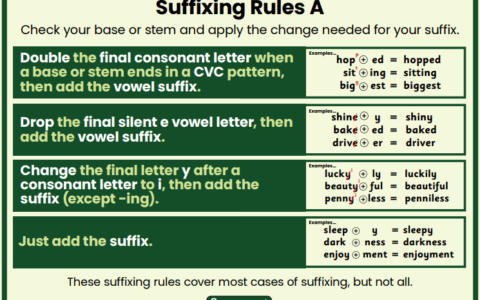
In Year 2, children begin learning about morphemes and the 4 suffixing rules. Support is provided where needed, but all children continue to take part in spelling lessons so that they can develop their understanding of how words are constructed.

As children move through Key Stage 2, the curriculum builds cumulatively. They begin with foundational concepts such as consonants, vowels and compound words before progressing to prefixes, suffixes, word families and more complex spelling patterns. Previously taught knowledge is revisited regularly, helping children make connections and apply strategies independently.

We do not rely on isolated weekly spelling tests. Instead, teachers use ongoing assessment and termly spelling checks to identify strengths, address misconceptions and plan future learning. Our aim is for children to understand not only how words are spelled, but also why they are spelled that way, giving them the tools to tackle unfamiliar words with confidence.

Through this approach, we support children to become accurate spellers, confident writers and enthusiastic users of language